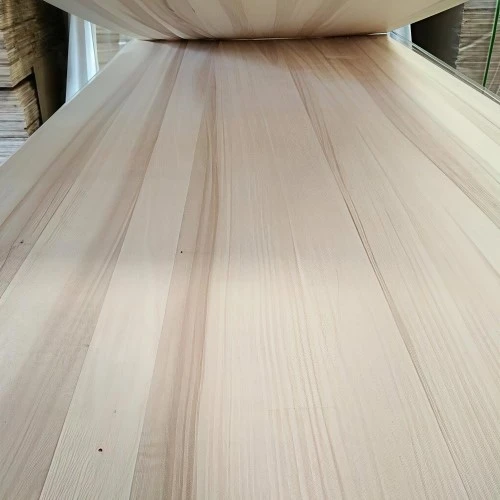
Poplar is a fast-growing tree species; consequently, its wood is widely used across various sectors.
1. Construction Sector
Poplar wood possesses high strength and durability, making it widely applicable in construction. It is used for structural components such as beams, columns, flooring, and roof trusses, as well as for door and window frames and furniture.
Plywood processing: Large- and medium-diameter logs (with a small-end diameter of over 18 cm and a length of 2.6 m) are used. The wood undergoes rotary cutting into veneers, drying, and hot pressing to produce plywood.
Particleboard and fiberboard processing: Poplar treetops, branches, and factory processing residues serve as raw materials; these are chipped and processed into particleboard and fiberboard.
Paper pulp processing: Small-diameter logs and branches are used; the wood can be mixed with coniferous wood.
Civil construction timber processing: Suitable for beam structures, purlins, rafters, ceilings, partitions, etc.
Packaging material processing: Poplar wood features straight grain, minimal swelling and shrinkage, medium-to-high impact toughness, good shock-absorbing properties, and no odor. It is easy to nail; while nail-holding power is relatively low, the wood is resistant to splitting. It is ideal for manufacturing packaging crates for military supplies, food, tea, pharmaceuticals, precision instruments, and more.
6. Matchstick processing: Poplar wood is soft with low density, straight grain, a fine and uniform texture, and a light color. It absorbs wax easily, making it an ideal raw material for matchsticks.
7. Blockboard processing: Logs or branches with a diameter of over 6 cm are sawn into blocks to form the core of blockboards, serving as raw material for their production.
8. Processing of other wood products: Suitable for making shovel heads, shovel handles, threshing tubs, toothpicks, ice cream sticks, etc.
Uses of Poplar Wood Boards